Persepolis, 1971
The Party That Fed a Revolution
A desert banquet designed to project eternal power — and remembered as a symbol of its collapse.
 90
90The story, with a little more room
About a 90-second read
Beyond the
90 seconds.
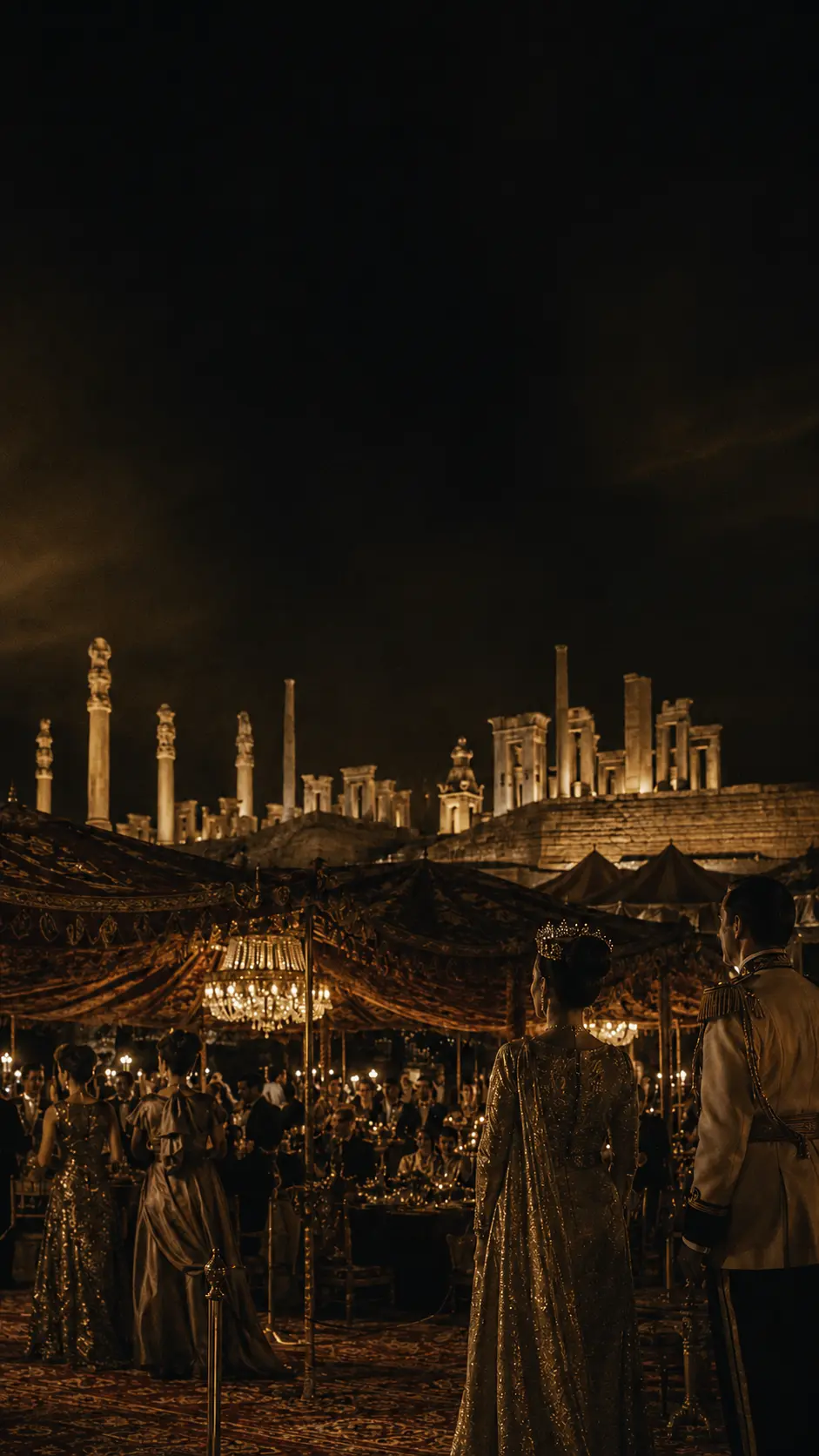
By the time the peacock reached the table, it had been roasted, stuffed with foie gras and reunited with its plumage. Few political metaphors have ever arrived so fully dressed.
For half a century, that bird has carried the historical verdict. It became Exhibit A against Mohammad Reza Pahlavi: a monarch staging imperial grandeur while his own country watched from outside the velvet ropes. Memorable, photogenic, politically lethal. Ayatollah Khomeini could hardly have commissioned a better image.
But the peacock also swallowed the footnotes.
The 1971 celebrations were not simply a three-day bonfire of public money. Beyond the French chefs, Baccarat chandeliers and Dom Pérignon in the desert, the programme included international exhibitions, academic conferences and the construction of more than 3,200 schools across rural Iran. Even the astronomical estimates of the festivities’ cost, repeated for decades as fact, remain disputed.
This does not rehabilitate the Shah. No number of provincial schools turns an autocrat into a misunderstood democrat or makes the gilded banquet less grotesque. It exposes a more useful contradiction: a political project can be serious in intention and disastrous in meaning.
The Shah wanted the world to see Iran as modern, ancient, powerful and indispensable. To prove it, he invited monarchs, presidents and dictators into an oasis of imported French silk. The guest list was global; the intended audience was foreign. Ordinary Iranians remained outside the security perimeter, watching on black-and-white televisions while universities were sealed and dissenters arrested.
That was the true bill for Persepolis. Not the champagne, the flown-in ice or even the peacock, but the distance between the story a regime told about itself and the country its people inhabited.
The banquet did not cause the Iranian Revolution. History is rarely so obliging. But it gave public resentment a stage set, a menu and one unforgettable bird.
Power had staged its own image. Its enemies only had to press replay.