Who was Homer?
The Man Behind the Epics
The poet behind the West’s foundational epics may be one of history’s most influential mysteries.
 90
90The story, with a little more room
About a 90-second read
Beyond the
90 seconds.
Homer has one of the more unusual biographies in literary history: almost every sentence in it requires a question mark.
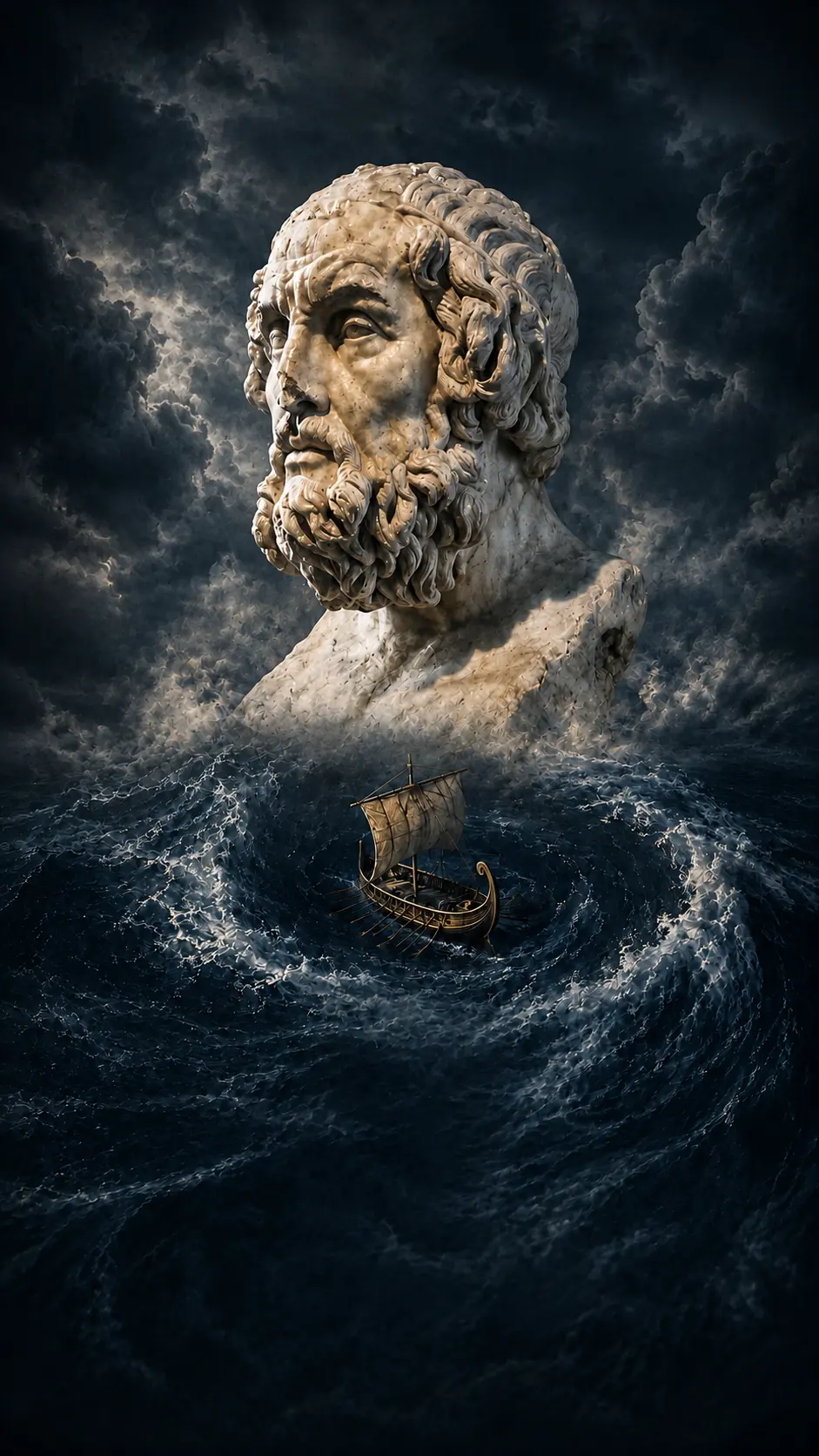
Tradition describes him as a blind Greek poet who lived sometime around the eighth century BC, probably in Ionia, on the eastern shores of the Aegean.
Cities competed for the honour of being his birthplace. Ancient artists invented a face for him. Generations of schoolchildren learned his name as naturally as those of Achilles and Odysseus.
The difficulty is that we have no contemporary biography, no manuscript written in his hand and no reliable evidence that the man later generations called Homer looked anything like the figure they imagined.
We are not even certain that one poet composed both the Iliad and the Odyssey.
The poems emerged from a much older oral culture in which professional singers memorised, performed and reshaped stories over generations. Repeated phrases such as “swift-footed Achilles” were not simply poetic decoration; they helped performers build enormous narratives in real time.
Some scholars therefore see Homer as an extraordinary individual who gave definitive form to inherited material. Others have wondered whether the name eventually became attached to a more collective process.
This uncertainty became famous enough to acquire its own title: the Homeric Question.
Almost three thousand years later, Christopher Nolan provided an unexpectedly expensive new chapter.
After Oppenheimer, Nolan chose the Odyssey for his next film, arguing that a story which had underpinned so much Western culture had never really been attempted with the resources of modern cinema. His 2026 adaptation, starring Matt Damon as Odysseus, became the first feature shot entirely on IMAX film cameras.
There is something wonderfully Homeric about that.
We still cannot prove exactly who created the Odyssey.
We can, however, spend hundreds of millions of dollars turning it into a blockbuster.
The author remains almost invisible.
The story, apparently, has no intention of disappearing.