Kallimarmaro
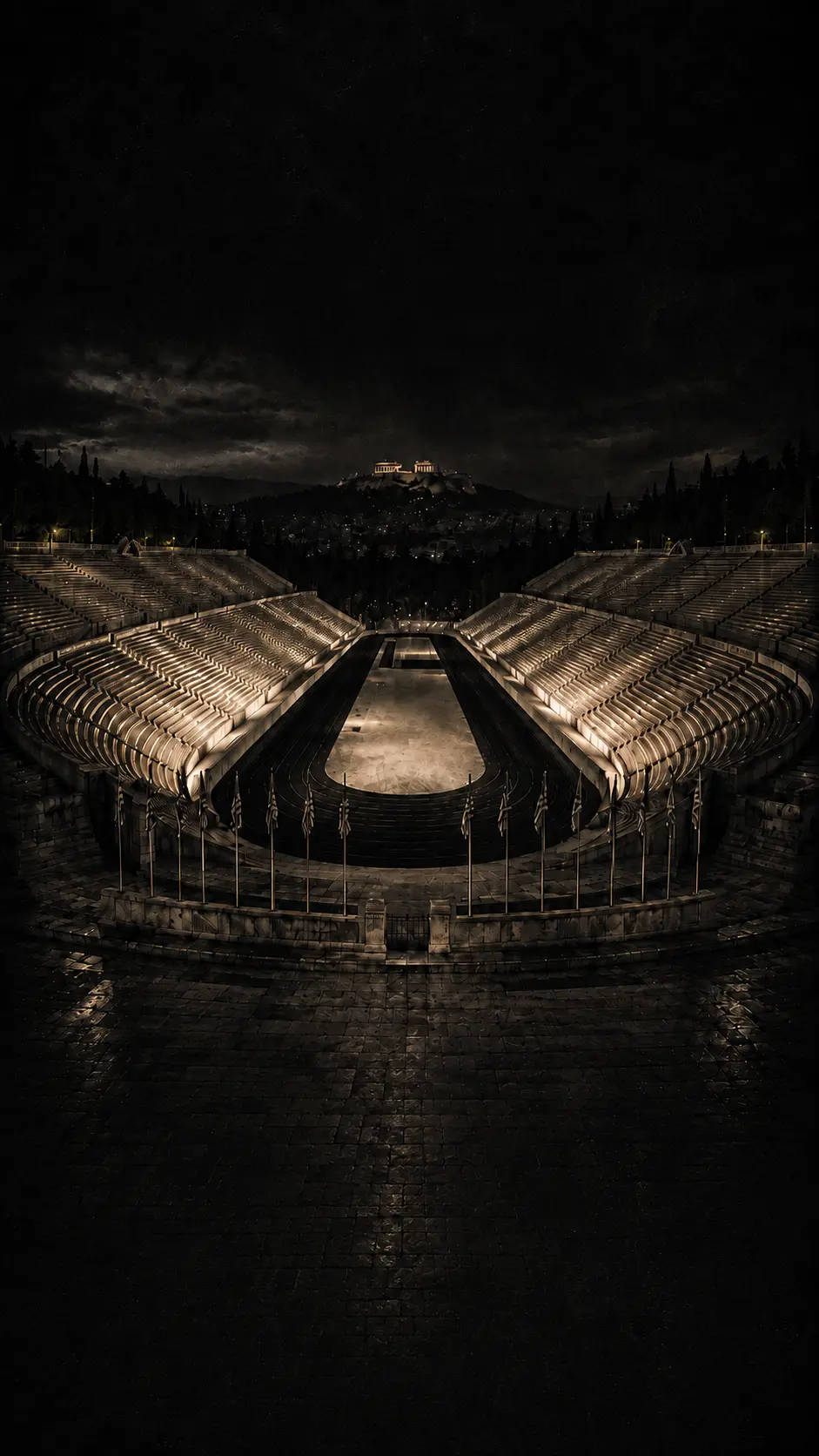
The Stadium Athens Keeps Bringing Back to Life
An ancient arena, a forgotten ruin and the marble stadium that gave the modern Olympics a home.
 90
90The story, with a little more room
About a 90-second read
Beyond the
90 seconds.
In 2026, Athens began washing the Panathenaic Stadium.
That sounds rather less dramatic than rebuilding it from antiquity, resurrecting the Olympic Games or sending thousands of marathon runners across its finish line.
But the cleaning and conservation of its marble was the first systematic intervention of its kind in more than a century — another chapter in the peculiar history of a monument Athens has repeatedly allowed to disappear and then chosen to bring back.
A stadium was first created in the natural hollow between the hills of Ardettos and Agra around 330 BC. In the second century AD, Herodes Atticus rebuilt it spectacularly in white marble.
Then history did what history often does.
The stadium fell out of use. Marble was removed. Earth slowly swallowed much of what remained.
By the nineteenth century, newly independent Greece was searching its ancient landscape for a usable past. Excavations led by Ernst Ziller revealed the old stadium, and when Athens was chosen to host the first international Olympic Games of the modern era in 1896, the ruins acquired a new job.
With Georgios Averoff financing the reconstruction and Anastasios Metaxas designing it around the excavated ancient form, the stadium returned in Pentelic marble.
Then came one of those moments history could hardly have scripted more efficiently.
Spyridon Louis entered the stadium to win the marathon at the first modern Olympics — a Greek runner completing a newly invented sporting event inspired by an ancient Greek legend inside a reconstructed ancient Greek stadium.
The loop never really closed.
Every year, runners in the Athens Authentic Marathon still follow the route from Marathon towards the city and finish inside the Kallimarmaro.
So when its marble is cleaned, Athens is not merely polishing an old monument.
The Panathenaic Stadium has survived precisely because every generation has found a new reason to use it.
It is ancient, reconstructed, modern and living at the same time.